Today, the problem of corruption can be encountered in almost every country in the world. In recent years, corruption has been one of the most widely discussed topics internationally as a transnational crime.
It should be noted that the damage caused by corruption is equal for all states, and this vice negatively affects various spheres of the state, in particular the reforms carried out in political, economic, social, and cultural spheres, as well as the country's image in the international arena and its investment attractiveness.
A number of regulatory legal acts on combating corruption have been adopted and are being implemented into practical life.
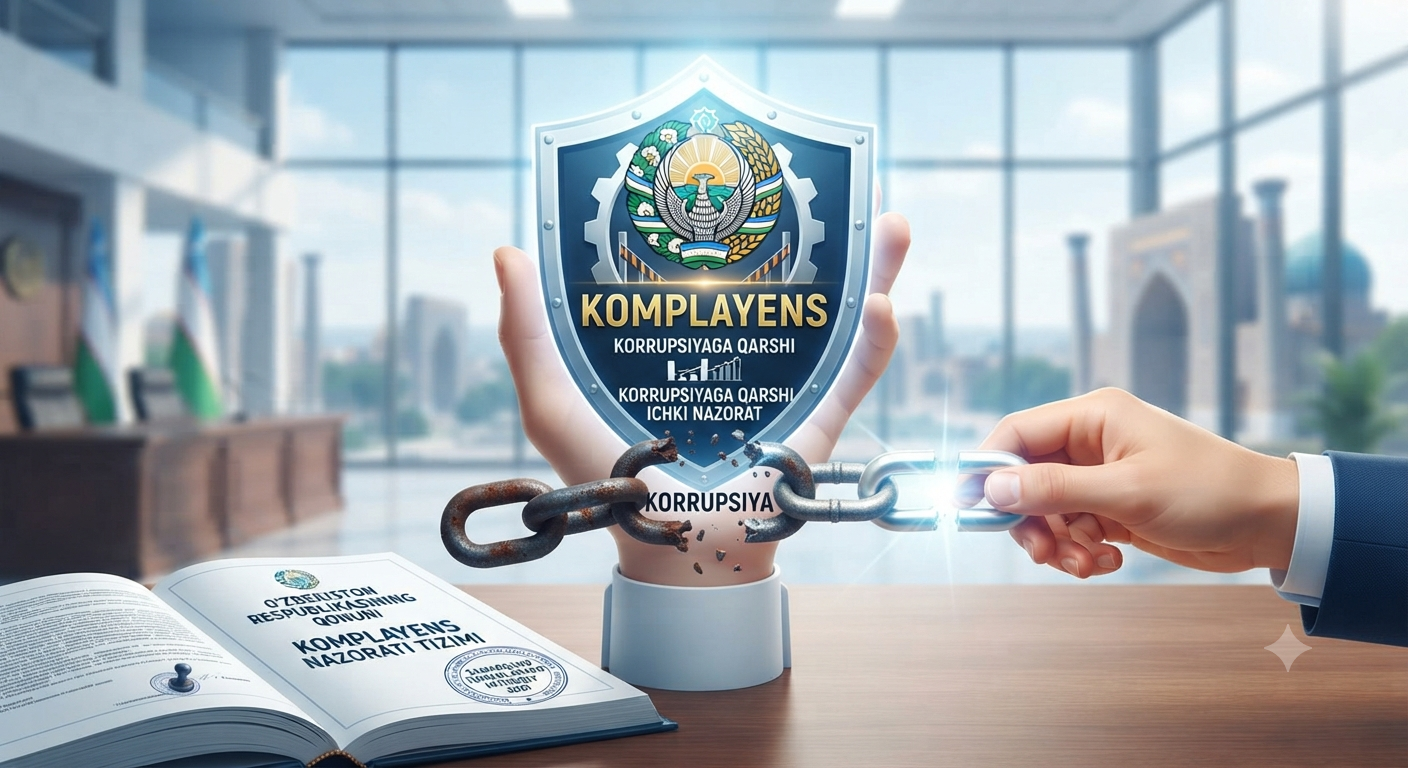
On June 23 of this year, the Law "On introducing additions and amendments to certain legislative acts of the Republic Uzbekistan aimed at increasing the effectiveness of anti-corruption measures and ensuring the inevitability of responsibility for corruption-related crimes" entered into force. This law also defines the powers, rights, and obligations of compliance and internal anti-corruption control structures in state bodies and organizations through a separate article.
Compliance and internal anti-corruption control structures, consisting of positions, services, and (or) units with certain law enforcement tasks in the field of combating corruption and related offenses, are established in state bodies and organizations in the manner prescribed by law.
Compliance and internal anti-corruption control structures of state bodies and organizations also possess other rights established by legislation.
If signs of corruption-related offenses are detected on the part of the top executives of state bodies and organizations, or if there are sufficient grounds to believe that they are patronizing the activities of a criminal group, their deputy for compliance and internal control, in agreement with the higher-level compliance and internal control service, shall have the right to directly submit relevant documents and information to law enforcement agencies, as well as to make proposals to temporarily suspend the right to make managerial decisions regarding personnel issues and financial expenditures, or to temporarily suspend the relevant executive or employee from performing their duties.
The activities of compliance and internal anti-corruption control structures in state bodies and organizations are coordinated by the Compliance Service of the Administration of the President of the Republic of Uzbekistan.
Anti-corruption compliance control is a preventive system that organizes the activities of state and economic management bodies, business entities in accordance with international standards, laws, and other regulatory legal acts in the field of combating corruption, ensuring the timely identification and suppression of corruption risks, conflicts of interest, and reporting violations of the law and corruption-related offenses.
Islom HAMROQULOV
Chairman of the Samarkand Interdistrict Economic Court
Elyor KHASANOV
Head of Chancery of the Samarkand Interdistrict Economic Court